
GEO for Construction: How Construction Firms Get Found in AI Search
When a project owner asks ChatGPT, Gemini, or Google AI Overviews who to hire for their next build, the answer is a shortlist. If your AEC or home services firm is not on it, you may never know the opportunity existed. Generative engine optimization (GEO) is how construction firms earn a place in those answers.
This guide covers:
- What GEO is, and why it changes how construction companies win work
- How AI systems decide which companies to mention: third-party proof, website legibility, and proprietary data
- A practical GEO strategy for your firm, plus how to track whether it is working
| What the AI needs to know | The signal it looks for | Where it finds that signal |
|---|---|---|
| Is this company real and reputable? | Reviews, ratings, active directory profiles | Google Business Profile, Houzz, Yelp, industry directories |
| Is it relevant to this specific job? | Service, location, and project-type pages | Your website |
| Where does this company work? | Service-area pages, city pages, project locations, local reviews, and consistent address or service-area details | Your website, Google Business Profile, directories, project pages |
| Is it recognized in the industry? | Awards, associations, press, "best of" lists | Third-party sites and publications, reinforced by an awards or press section on your own website |
| Does it actually know its craft? | Original data, benchmarks, quantified case studies | Your blog and resource hub |
| Can the details be verified? | Consistent name, services, locations, and claims | Everywhere your company appears online |
1. What GEO Is and How It Affects Construction Companies
Generative engine optimization (GEO) is the practice of shaping and structuring your online content so it gets recommended by AI-powered search engines. The field emerged after ChatGPT launched, and early research from Princeton in 2024 confirmed that deliberate changes to how content is written and sourced can increase the odds of being cited by an AI.1
For construction, GEO does two jobs at once. First, it positions your company as a thought leader because when your firm appears consistently across relevant AI answers, buyers start to recognize you as an expert in your field. Second, and most importantly, it wins projects, because buyers increasingly ask AI for hiring recommendations before they ever open a browser tab. If AI shortlists your firm, you enter the conversation earlier and with borrowed trust.
The mental shift looks like this:
| Traditional SEO | GEO | |
|---|---|---|
| Core question | "How do I rank #1?" | "How do I create enough independent, consistent evidence that an AI can confidently include me when a user asks a relevant question?" |
| Success looks like | A blue link on page one | Your firm named inside the AI's answer for transactional queries |
| Who controls the outcome | Google's ranking of your pages | Every source about you, plus your own site |
| Key battleground | Keywords and backlinks | Reviews, lists, directories, and verifiable claims |
Ranking still matters. The lists and pages that rank highly on Google and Bing are exactly where chatbots pull their recommendations from.2 GEO builds on SEO rather than replacing it.
2. How GEO Works: What Determines If You Get Mentioned
Every AI recommendation comes down to one question: what evidence can the system find that makes it confident enough to mention your company for this particular query?
GEO is about building enough clear, consistent, and independently validated evidence that AI systems can confidently understand your company, determine that you're relevant to a specific query, and mention you as an answer.
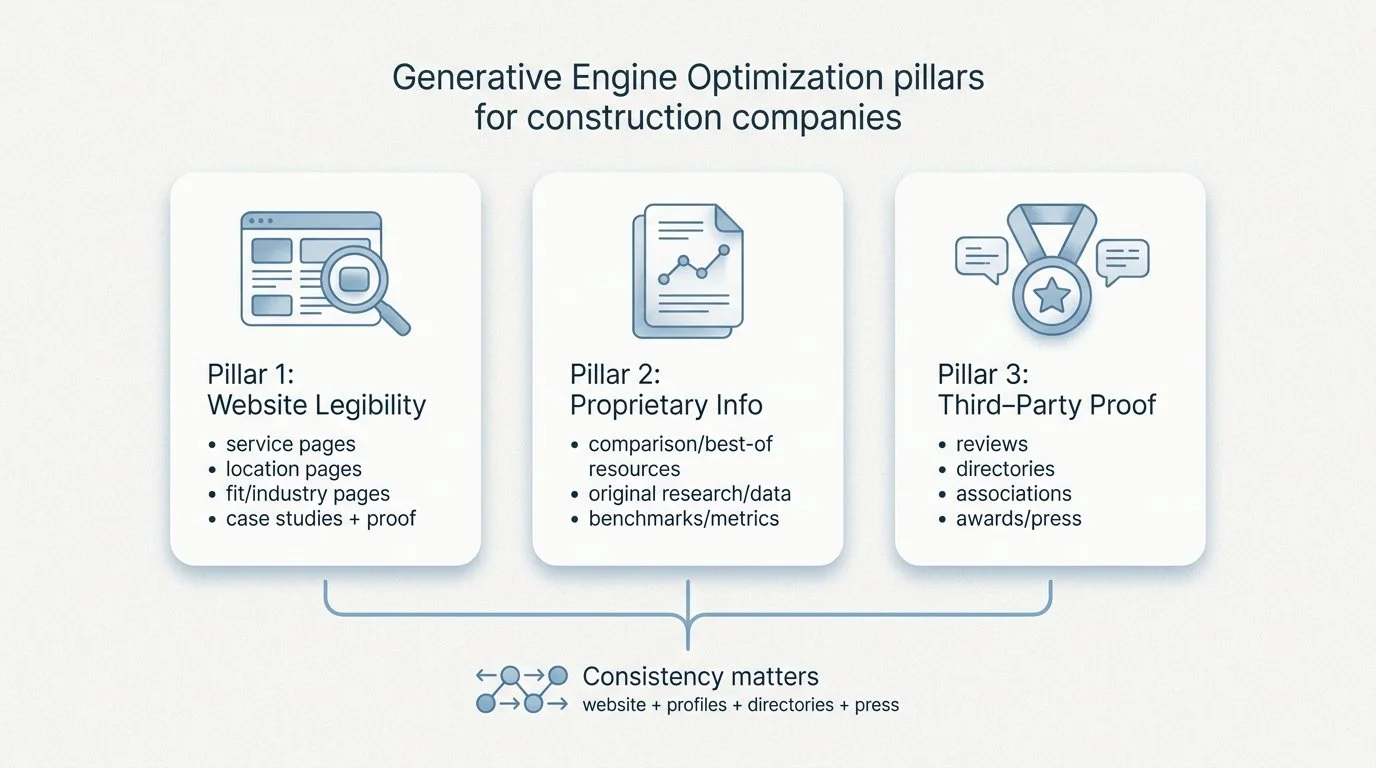
That evidence falls into three pillars.
Pillar 1: Make your own website extremely legible
Structure your site so an AI can quickly understand who you are, what you do, where you do it, who you're for, and what you've actually accomplished:
- Service pages for each trade or delivery model
- Location pages for every market you serve
- Service-area details that make your geographic coverage clear
- Industry and fit pages (healthcare, hospitality, industrial, and so on)
- Case studies with quantified results
- Awards, project portfolios, and team expertise
- Clear company and entity information
The goal: "Here's exactly what this company is and why it's relevant."
Picture a buyer asking, "Who should I hire for a restaurant buildout in Austin?" A vague "full-service construction company" page gives AI almost nothing to work with. A page showing restaurant buildout experience, Austin service coverage, project photos, reviews, and a simple inquiry path gives it a concrete reason to include you.
Pillar 2: Create proprietary information worth citing
Publish evidence and expertise that makes your company an information source:
- Your own "best of" and comparison resources
- Original research and industry data
- Market reports and proprietary metrics
The goal: "This company actually knows something worth using as evidence."
Underneath all three pillars sits one principle:
Consistency matters.
If your website, Google profile, directories, press, reviews, awards, and industry sites all describe the same entity and expertise, AI connects the dots easily. If they conflict, confidence drops and so do your mentions.
Pillar 3: Build third-party proof
Get other credible sources to establish that your firm is real, reputable, relevant, and recognized:
- Reviews (critical for regional contractors)
- Directory profiles with reviews and signs of activity
- Industry associations and accreditations
- Awards and press coverage
- Project databases
- Third-party "best of" lists
- Other websites mentioning your company and projects
The goal: "Other people validate this company."
Two findings from First Page Sage's research, one of the largest GEO studies to date with over 11,000 AI queries tested, stand out. Appearing in list articles that rank highly on Google is the single biggest driver of chatbot recommendations, and review scores below 3.5 stars make a recommendation unlikely.2 In other words, third-party proof is not a nice-to-have. It is the entry ticket.
| Pillar | What to build | The goal |
|---|---|---|
| Pillar 1 Website legibility |
|
"Here's exactly what this company is and why it's relevant." |
| Pillar 2 Proprietary information |
|
"This company actually knows something worth using as evidence." |
| Pillar 3 Third-party proof |
|
"Other people validate this company." |
3. How to Get Found: GEO Strategy and Tracking
To get found, your website and online profiles need to make three things clear fast: what you build, where you work, and why buyers should trust you. In practice, that means AI search visibility depends on specific service pages, location pages, project examples, reviews, licenses, consistent business information, and content that answers real hiring questions.
Two content types carry most of the weight:
Comparison blogs. Articles that compare companies, approaches, or costs by features, pricing, and use case are the format chatbots quote most often, because they mirror how AI assembles its shortlists.2 Publish them on your own site and include your firm where it genuinely fits. Examples: "Design-Build vs. General Contractor: Which Delivery Method Fits Your Project?" or "The Top Commercial Contractors in [Your Metro]."
Decision pages. Your service, location, and fit pages are the pages AI checks to confirm relevance. Each one should answer: what work, where, for whom, at what scale, and with what proof.
A realistic weekly time allocation for a marketing lead running GEO:
| Activity | Weekly time | Why it matters |
|---|---|---|
| Publishing comparison blogs and metrics pieces | 3 to 5 hours | Builds the ranked lists chatbots quote |
| Securing reviews and directory placements | 1 hour | Reviews below 3.5 stars kill recommendations |
| Structuring service and location pages | 1 to 2 hours | Helps AI understand what you do, where you work, and which buyers you serve |
| Publishing case studies and project proof | 1 to 2 hours | Gives AI concrete evidence of your experience, results, and credibility |
| Publicizing awards, press, and associations | 1 hour | Feeds the reputation signals that order AI shortlists |
| Running prompt tracking | 30 minutes | Tells you what is actually working |
How to track success
AI answers change from day to day, so one-off checks mislead. Build a lightweight tracking habit:
- Option 1: Keep a manual prompt tracker: a spreadsheet of 10 to 20 buyer-style prompts ("best commercial GC in [city]," "who should I hire for a medical office buildout") with dates and results. Run the prompts when possible on an incognito account.
- Option 2: Use a dedicated AI visibility tracker such as Writesonic or Geoptie to automate monitoring across ChatGPT, Gemini, and AI Overviews.
- Run your prompts consistently, daily if you can. Frequency is what turns scattered observations into a trend line you can act on.
Conclusion
AI search has become the first round of every construction hiring decision. The firms that show up in those answers are the ones with the most consistent, independently verified evidence: reviews and lists that vouch for them, a website that makes their relevance obvious, and original data that proves they know their craft. Start with one pillar this quarter, track your prompts weekly, and let the flywheel compound.
Sources
- Aggarwal et al., "GEO: Generative Engine Optimization," Princeton University, 2024. arxiv.org/pdf/2311.09735
- First Page Sage, "Generative Engine Optimization (GEO) Strategy Guide," updated May 2026. firstpagesage.com
- First Page Sage, "Generative Engine Optimization (GEO) Explanation: Chatbot Algorithm Study." firstpagesage.com
