
AI Search Visibility Metrics & KPIs: 2026 Report
Last updated October 20, 2026
Each KPI answers one question. The last column shows where to find the number.
The AI Search Visibility KPIs You Can Measure: 2026
Each KPI answers one question. The last column shows where to find the number.
The AI Search Visibility KPIs - 2026
| KPI | What it tells you | How to calculate it | What good looks like | Where to track it |
|---|---|---|---|---|
| AI visibility rate | How often AI names your brand for prompts you care about | Answers that name you ÷ all answers | The top brands in one study showed up in 55% to 77% of answers [8]. Aim to rise each month. | AI visibility tracker or a manual prompt log |
| AI citation share | How often AI links to your site compared with others | Links to your site ÷ all links in the answers | More links each month than your closest rivals | AI visibility tracker |
| Cited click rate | How often people click your link when Google's AI Overview cites you | Clicks ÷ impressions on cited searches | Cited brands got more than twice the clicks of uncited brands in 2025 [7] | Google Search Console plus an AI Overview tracker |
| Organic traffic | Visits from regular Google and Bing results | Organic sessions per month | Flat or rising while AI Overviews spread | Web analytics, Search Console |
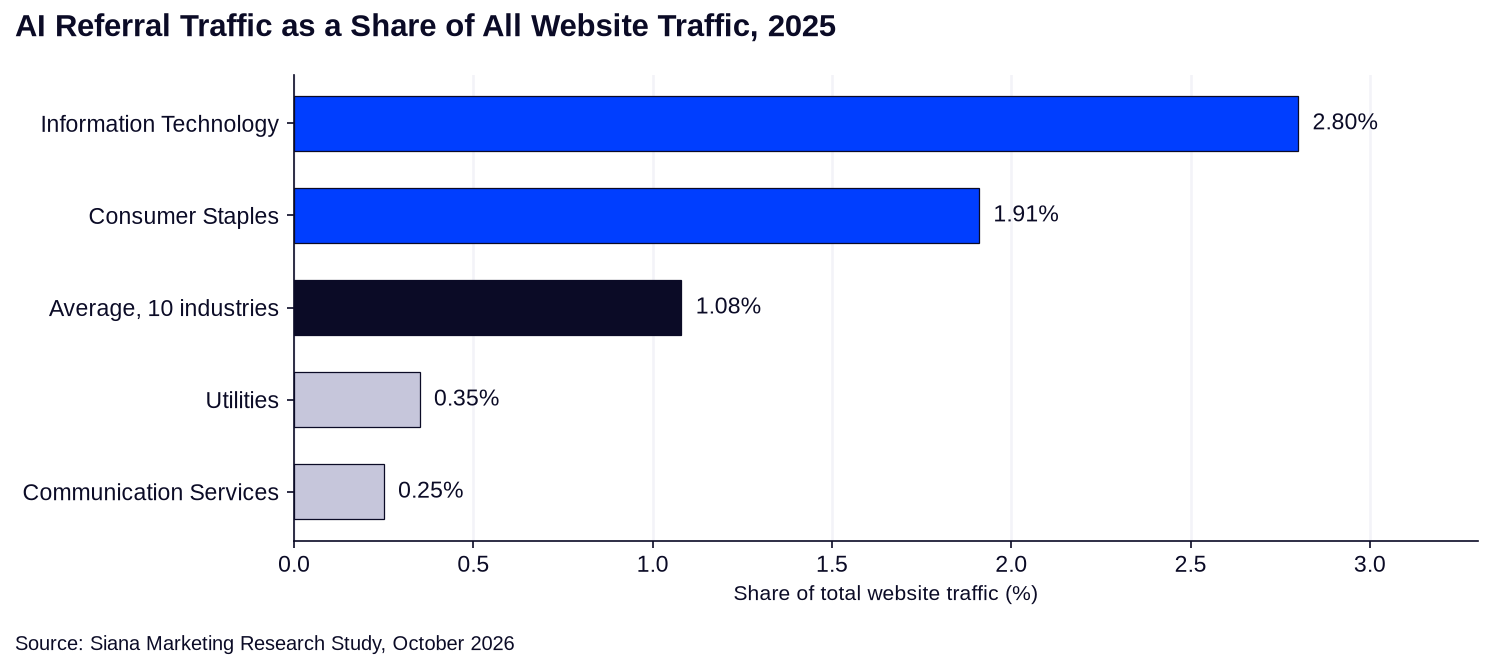
| AI referral traffic | Visits that come from ChatGPT, Perplexity, Gemini and similar tools | Sessions with an AI tool as the source | About 1 in 100 visits across 10 industries in 2025 [6]. Aim to rise each month. | Web analytics with an AI channel group |
| Direct traffic to deep pages | Visits with no source, often from AI links that lose their tag | Direct sessions to service, project and blog pages | A rise that moves with your AI visibility rate | Web analytics, filtered by landing page |
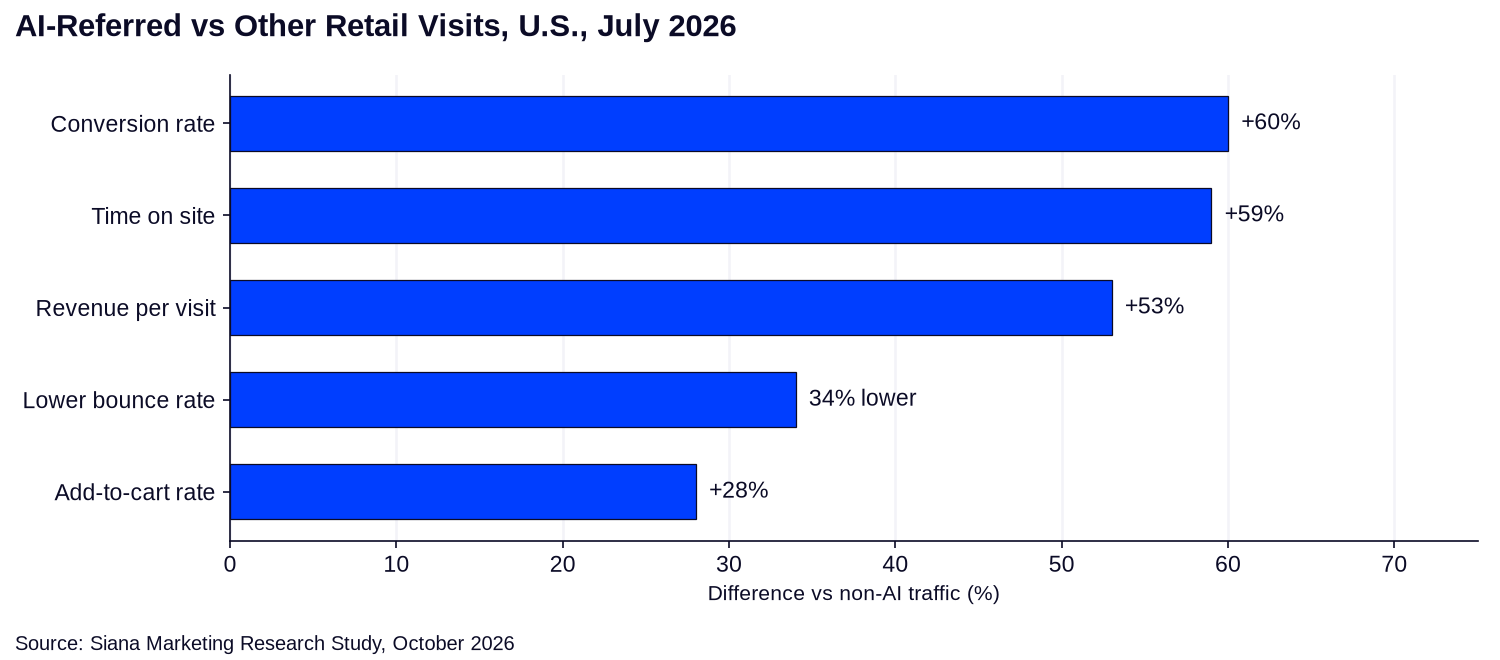
| AI visitor conversion rate | How often AI visitors call, fill a form or buy | AI conversions ÷ AI sessions | AI visitors converted 60% better than others on U.S. retail sites in July 2026 [9] | Web analytics, CRM |
| AI visitor bounce rate | How often AI visitors leave after one page | One-page AI sessions ÷ AI sessions | 17% to 20% for AI visitors, about 27% for others, U.S. retail [9] | Web analytics |
| Self-reported AI source | How many leads say AI sent them | Leads that pick an AI tool ÷ all leads | A clear count you can compare month to month | A "How did you hear about us?" field on forms |
We found that:
- Visibility rate is a usable KPI. Rank inside an AI answer is not. AI tools gave the same brand list in the same order in under 1 run in 1,000 [8].
- AI referral traffic is small but converts. It made up 1.08% of visits in 2025 [6], yet AI visitors to U.S. retail sites converted 60% better in July 2026 [9].
- Direct traffic now hides part of AI traffic. After GPT-6 launched in October 2026, about 500 pages lost about 31,000 ChatGPT visits a day and gained about 26,000 direct visits a day [10].
How to Choose Your Top 3 KPIs
Most teams can't track 9 KPIs well. We suggest 3 leading indicators, because they move before leads and sales do.
The Top 3 AI Search KPIs - 2026
| KPI | Why it leads | What to watch |
|---|---|---|
| 1. Organic traffic | Search engines still send most site traffic. Industrials, the sector that includes construction, got 33.8% of its traffic from organic search in 2025 [6]. | Month-over-month change on service pages |
| 2. AI visibility rate | AI answers shape the shortlist before anyone visits your site. Only 1% of visits to a Google page with an AI summary led to a click on a link inside it [1]. | Share of your prompt list that names you |
| 3. AI referral traffic | It shows when visibility turns into visits. Count direct traffic to deep pages next to it, since part of AI traffic lands there [10]. | AI sessions plus direct sessions to deep pages |
Conversions and revenue follow these 3. Track them too, but expect them to lag by weeks or months.
How to Build a Curated Prompt List
Your visibility rate is only as good as your prompts. Pick the prompts you want to win, the ones a buyer types when ready to hire.
- Start with transactional prompts. These name a service, a place or a budget.
- Add comparison prompts. Google showed an AI Overview on 95.4% of comparison searches in early 2026 [7].
- Write prompts the way buyers talk. In one study, 142 people with the same goal wrote prompts with a similarity score of 0.081 out of 1 [8]. Use several wordings for each goal.
- Keep the list to 25 to 50 prompts so you can review the answers.
- Run each prompt every day and record whether your brand appears.
Example Prompts for a Construction or B2B Buyer (examples only)
| Buyer goal | Example prompt |
|---|---|
| Hire a contractor | Who are the best commercial general contractors in Denver for a 40,000 sq ft office build? |
| Compare options | Design-build vs design-bid-build for a mid-size warehouse: which firms do both well in Texas? |
| Check price | How much does a tenant improvement project cost per square foot in Chicago, and who should I call? |
| Find a specialist | Which construction firms specialize in healthcare facilities in the Pacific Northwest? |
| Vet a vendor | Is [your company name] a good choice for a school renovation? |
Why run them daily? AI answers change from run to run. Two runs of the same prompt gave the same brand list less than 1 time in 100 [8]. The study's authors suggest 60 to 100 runs per prompt before you trust a visibility rate. Daily runs build that sample in 2 to 3 months, and the trend line smooths out the noise.
How to Set a Baseline
A baseline is your starting point. Without one, you can't show change.
- Pick a start date and add a note in your analytics.
- Run your full prompt list for 30 days and record your visibility rate for each AI tool.
- Pull 3 months of organic, AI referral and direct traffic from web analytics.
- Set up an AI channel group so AI visits stop landing in "referral" or "other."
- Add a "How did you hear about us?" field to your forms with ChatGPT, Gemini and Perplexity as options.
- Mark known tracking breaks. Note October 8 to 16, 2026, when many ChatGPT links lost their tracking tags [10], [11].
Monthly AI Search Reporting Template
Copy this table into a sheet. Fill it in on the same day each month, or each week if you have the data.
The AI Search KPI Report Template - 2026
| KPI | This month | Last month | Change | Baseline | Note |
|---|---|---|---|---|---|
| Organic sessions | |||||
| AI visibility rate (all prompts) | |||||
| AI visibility rate (transactional prompts) | |||||
| AI referral sessions | |||||
| Direct sessions to deep pages | |||||
| Cited click rate (Search Console) | |||||
| AI visitor conversions | |||||
| Leads that named an AI tool |
Add one line of context under the table: a tracking break, a new page or a model launch.
Which Tool Types Track Each KPI
You don't need one tool for everything. These tool types cover the KPIs above.
The AI Search KPI Tracking Tools - 2026
| Tool type | KPIs it covers | Watch out for |
|---|---|---|
| Web analytics | Organic, AI referral and direct traffic, conversions, bounce rate | AI visits can show as direct when links lose their tags [10] |
| Search engine console | Organic clicks, impressions and click rate | Google counts AI Overview and AI Mode clicks together with organic clicks [6] |
| AI visibility tracker | Visibility rate, citation share | Ask how many times it runs each prompt [8] |
| Manual prompt log (a spreadsheet) | Visibility rate for a short list | Slow, but you see every answer |
| CRM and form fields | Self-reported AI source, lead quality | Depends on honest answers |
Common Measurement Mistakes
- Tracking rank inside an AI answer. The order changes almost every run [8].
- Judging from one screenshot. One answer is one draw. Use the rate across many runs.
- Reading a drop in AI referrals as lost visibility. Check direct traffic to deep pages first [10].
- Reading click rate alone. Cited impressions more than doubled from September to October 2025 while clicks stayed flat, so click rate fell with no loss of clicks [7].
- Using only informational prompts. Buyers who are ready to hire type transactional prompts.
- Comparing numbers from different studies as if they were one measure. Each study has its own industries, dates and sites.
The Data Behind These KPIs: 2026
These benchmarks give context for your own numbers. Each row keeps its own scope and date.
The AI Search Benchmarks - 2025 to 2026
| Measure | Value | Scope and date | Source |
|---|---|---|---|
| ChatGPT users | More than 1.2 billion a week | Global, October 2026 | [5] |
| Google AI Overviews users | More than 2.5 billion a month | Global, 2026 | [3] |
| Google AI Mode users | More than 1 billion a month | Global, July 2026 | [4] |
| Clicks on a regular result when an AI summary showed | 8% of visits (15% with no summary) | U.S. adults, March 2025 | [1] |
| People who rely on AI answers for at least 40% of searches | About 80% | U.S. survey, December 2024 | [2] |
| Searches that showed an AI Overview | 25.11% | U.S., 10 industries, fall 2025 | [6] |
| AI share of website traffic | 1.08% (IT 2.80%, Communication Services 0.25%) | U.S., 10 industries, May to September 2025 | [6] |
| Share of AI referrals from ChatGPT | 87.4% | U.S., 10 industries, 2025 | [6] |
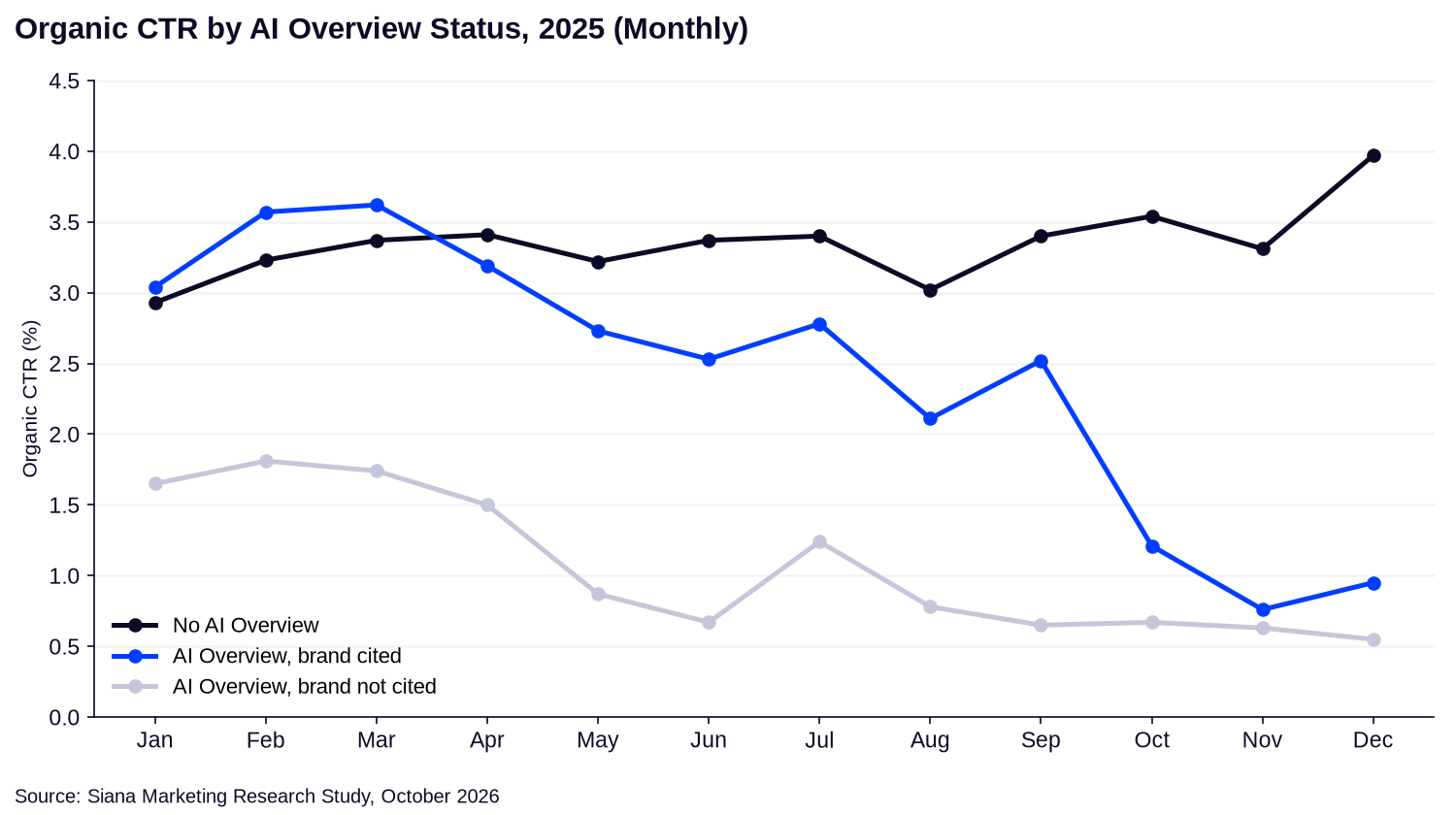
| Organic click rate, informational searches | 3.35% no AI Overview, 2.07% cited, 0.94% not cited | 53 brands, 2025 average | [7] |
| Growth of AI visits to retail sites | +62% year over year | U.S. retail, July 2026 | [9] |
We found that:
- A citation adds about 11,298 clicks* per 1 million informational impressions. We subtracted uncited clicks (9,445) from cited clicks (20,743), both per 1 million impressions [7].
- Local searches are exposed. "Near me" informational searches showed an AI Overview 76.9% of the time in early 2026 [7]. Contractors who win on local search should watch AI answers too.
- The market around these KPIs keeps growing. See our GEO market size report for spend estimates.
*Our estimate, built from the sourced figures shown.
AI Search KPI FAQ
What is the most important AI search visibility KPI? AI visibility rate: the share of your chosen prompts where AI names your brand. Track it with organic traffic and AI referral traffic.
How often should I check AI visibility? Run your prompts daily and report monthly. AI answers change from run to run, so a single check can mislead you.
Why did my ChatGPT traffic drop in October 2026? Many ChatGPT links lost their tracking tags from October 8 to 16, 2026, so visits showed up as direct traffic [10], [11]. Check direct traffic to deep pages for the same dates.
Do I still need SEO if I track AI visibility? Yes. Organic search still sends far more traffic than AI tools. AI sent 1.08% of visits in 2025 across 10 industries [6]. Our AI SEO best practices guide covers both.
Requesting a Copy of This Report
Start with 3 KPIs: organic traffic, AI visibility rate and AI referral traffic. Build a prompt list you want to win, run it daily, set a 30-day baseline and fill in the template each month. If you'd like to request a PDF copy of this report or learn more about our agency, you can reach out here.
Sources
- Google users are less likely to click on links when an AI summary appears in the results, Pew Research Center, July 2025, Washington, D.C.
- Goodbye Clicks, Hello AI: Zero-Click Search Redefines Marketing, Bain & Company, February 2025, Boston.
- New opportunities, control and insights for website owners, Google, 2026, Mountain View, California.
- Alphabet Q2 2026 Earnings Call, Alphabet, July 2026, Mountain View, California.
- GPT-6 and Intelligent UI for everyone, OpenAI, October 2026, San Francisco.
- The 2026 AEO / GEO Benchmarks Report, Conductor, updated July 2026, New York.
- AIO Impact on Google CTR: 2026 Update, Seer Interactive, April 2026, Philadelphia.
- AIs are highly inconsistent when recommending brands or products, SparkToro and Gumshoe, January 2026, Seattle.
- AI Traffic Trends Report, Adobe Digital Insights, August 2026, San Jose, California.
- ChatGPT appears to drop UTM tracking, making AI referral traffic harder to measure, Search Engine Land, October 2026, Washington, D.C.
- ChatGPT's missing UTM tags: what happened from October 8 to October 16, Profound, October 2026, New York.
Written by Daniela Pedroza, Founder and CEO, Siana Marketing. Daniela holds a Master of Architecture from UC Berkeley and a Bachelor of Architecture from the Technical University of Munich, and brings marketing experience from Apple and HENN Architects to SEO and content strategy for construction businesses.